
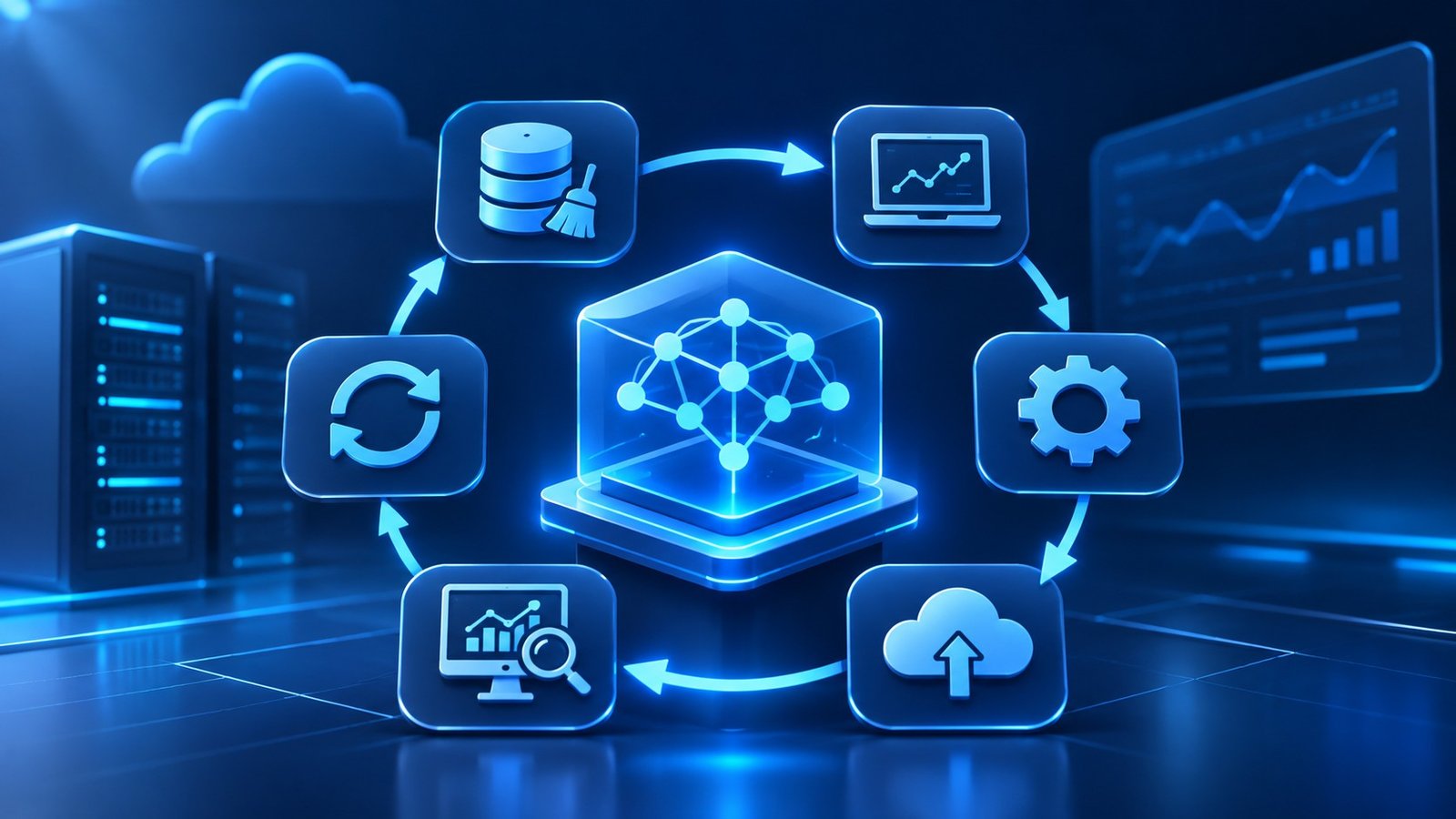
Building a machine learning model is only one part of creating a useful AI system.
A model may perform well during testing, but that does not automatically mean it is ready for real-world use.
Once a model moves into production, new challenges appear.
Teams need to think about deployment, monitoring, versioning, data changes, model performance, and future updates.
This is where MLOps becomes important.
MLOps stands for Machine Learning Operations.
It combines machine learning practices with automation and operational processes to help teams manage AI systems more reliably.
For businesses using AI in production, MLOps can make the difference between a model that only works in a notebook and a system that can actually be used at scale.
What Is MLOps?
MLOps is a set of practices used to manage the complete lifecycle of machine learning models.
This lifecycle can include:
- data preparation;
- model training;
- experiment tracking;
- testing;
- deployment;
- monitoring;
- retraining;
- version control.
The purpose of MLOps is to make these processes more organized, repeatable, and easier to manage.
Without MLOps, machine learning projects can become difficult to maintain.
For example, a team may train a model successfully but later struggle to remember which dataset, configuration, or model version was used.
MLOps helps create a structured process around these activities.
Why Machine Learning Projects Become Difficult After Deployment
During development, data scientists may experiment with many different models.
They may change:
- algorithms;
- training data;
- parameters;
- features;
- model settings.
Eventually, one version performs better and is selected.
But once the model is deployed, several new questions need to be answered.
Which model version is currently running?
Which dataset was used to train it?
What happens if the model performance decreases?
How can a new model version be deployed safely?
How can the previous version be restored if something goes wrong?
These are not only machine learning questions.
They are operational questions.
MLOps provides practices and tools to handle them.
Model Versioning Makes AI Systems Easier to Manage
Machine learning models change over time.
A team may train several versions before selecting the best one.
Without versioning, it can become difficult to understand which model is being used and why.
MLOps workflows help teams track:
- model versions;
- code versions;
- datasets;
- experiments;
- performance metrics.
This makes the development process more transparent.
For example, imagine a team creates five versions of a customer churn prediction model.
Each model uses slightly different data and parameters.
If the team tracks those experiments properly, it becomes easier to compare the results and understand why one model was selected.
This is much better than depending on manual notes or memory.
Experiment Tracking Helps Teams Compare Models
Machine learning development involves a large amount of experimentation.
A data scientist may try different algorithms, training methods, or parameters before reaching the final model.
Experiment tracking tools help store information about each experiment.
This may include:
- model parameters;
- evaluation metrics;
- datasets;
- training duration;
- results.
Tools such as MLflow are often used for this purpose.
The main benefit is consistency.
Teams can compare experiments and understand which approach produced the best results.
For businesses investing in AI, this can reduce confusion and make model development more organized.
MLOps Helps Automate Model Deployment
A machine learning model has limited value if it only works inside a development environment.
To provide business value, the model usually needs to become part of an application or workflow.
For example, a model may be used to:
- detect fraud;
- predict customer behaviour;
- classify documents;
- recommend products;
- analyze images;
- forecast demand.
MLOps pipelines can help automate the process of preparing and deploying models.
Instead of manually repeating every deployment step, teams can create a structured workflow.
A simplified process might look like this:
A model is trained.
The model is tested.
Performance is evaluated.
The model is packaged.
The model is deployed.
The running model is monitored.
Automation can make this process faster and more consistent.
AI Models Need Monitoring After Deployment
One of the biggest differences between traditional software and machine learning systems is that model performance can change even when the code does not.
This can happen because real-world data changes.
Imagine a model trained on customer behaviour from last year.
Over time, customer behaviour may change.
The model may continue running normally, but its predictions may become less accurate.
This is why AI model monitoring is important.
Teams may need to monitor:
- prediction accuracy;
- input data;
- output patterns;
- system performance;
- model drift;
- data drift.
Monitoring helps teams identify when a model may need to be reviewed or retrained.
What Is Model Drift?
Model drift happens when a machine learning model becomes less effective because the environment or data has changed.
For example, a fraud detection model may be trained using historical transaction patterns.
If fraud behaviour changes significantly, the original model may become less accurate.
The model itself may still be running correctly.
The problem is that the real-world patterns are different from the patterns it learned during training.
Monitoring can help identify this change.
The team can then decide whether the model needs to be retrained with newer data.
MLOps Can Improve Collaboration
Machine learning projects often involve several different roles.
These may include:
- data scientists;
- machine learning engineers;
- software developers;
- DevOps engineers;
- business teams.
Without clear processes, collaboration can become difficult.
For example, a data scientist may build a model that works locally, but the engineering team may not know how to deploy it efficiently.
MLOps creates a more structured connection between model development and production systems.
This can help teams work more effectively together.
Automation Makes Machine Learning Workflows More Reliable
Manual processes can create problems in machine learning projects.
If every training or deployment step is performed manually, the process may be difficult to repeat.
Automation can improve consistency.
For example, an automated machine learning pipeline may:
- collect updated data;
- validate the data;
- train a new model;
- evaluate model performance;
- compare the new model with the existing model;
- deploy the new version if it meets requirements.
This does not mean every AI project needs full automation.
The level of automation should depend on the complexity and maturity of the project.
When Does a Business Need MLOps?
Not every AI project requires a complete MLOps platform.
For a small experiment or prototype, a simple process may be enough.
MLOps becomes more important when businesses begin using machine learning in production.
It may be useful when:
- multiple models are being managed;
- models are updated regularly;
- different teams work on the same AI system;
- deployment needs to be repeatable;
- model performance needs continuous monitoring;
- large datasets change frequently;
- businesses depend on AI predictions for important decisions.
The more important the model becomes to business operations, the more important reliable machine learning processes become.
How NextVora Solutions Supports MLOps & AI Projects
NextVora Solutions provides MLOps & AI services for businesses that want to move from AI experimentation toward more structured production systems.
Depending on project requirements, this may include areas such as:
- machine learning model deployment;
- experiment tracking;
- ML pipeline automation;
- model versioning;
- AI model monitoring;
- containerized ML environments;
- cloud-based machine learning infrastructure;
- MLflow-based workflows.
The goal is not simply to deploy an AI model.
The goal is to create a process that makes the model easier to manage, monitor, update, and improve over time.
For businesses using AI in real operations, this structure can help reduce technical complexity and improve reliability.
Final Thoughts
Machine learning does not end when a model is trained.
A successful AI system also needs deployment, monitoring, versioning, testing, and maintenance.
This is what MLOps helps manage.
By combining machine learning with structured operational practices, businesses can make AI systems more reliable and easier to scale.
For organizations that want to move from AI experiments to production-ready systems, the right MLOps services can provide the foundation needed to manage machine learning models throughout their complete lifecycle.