
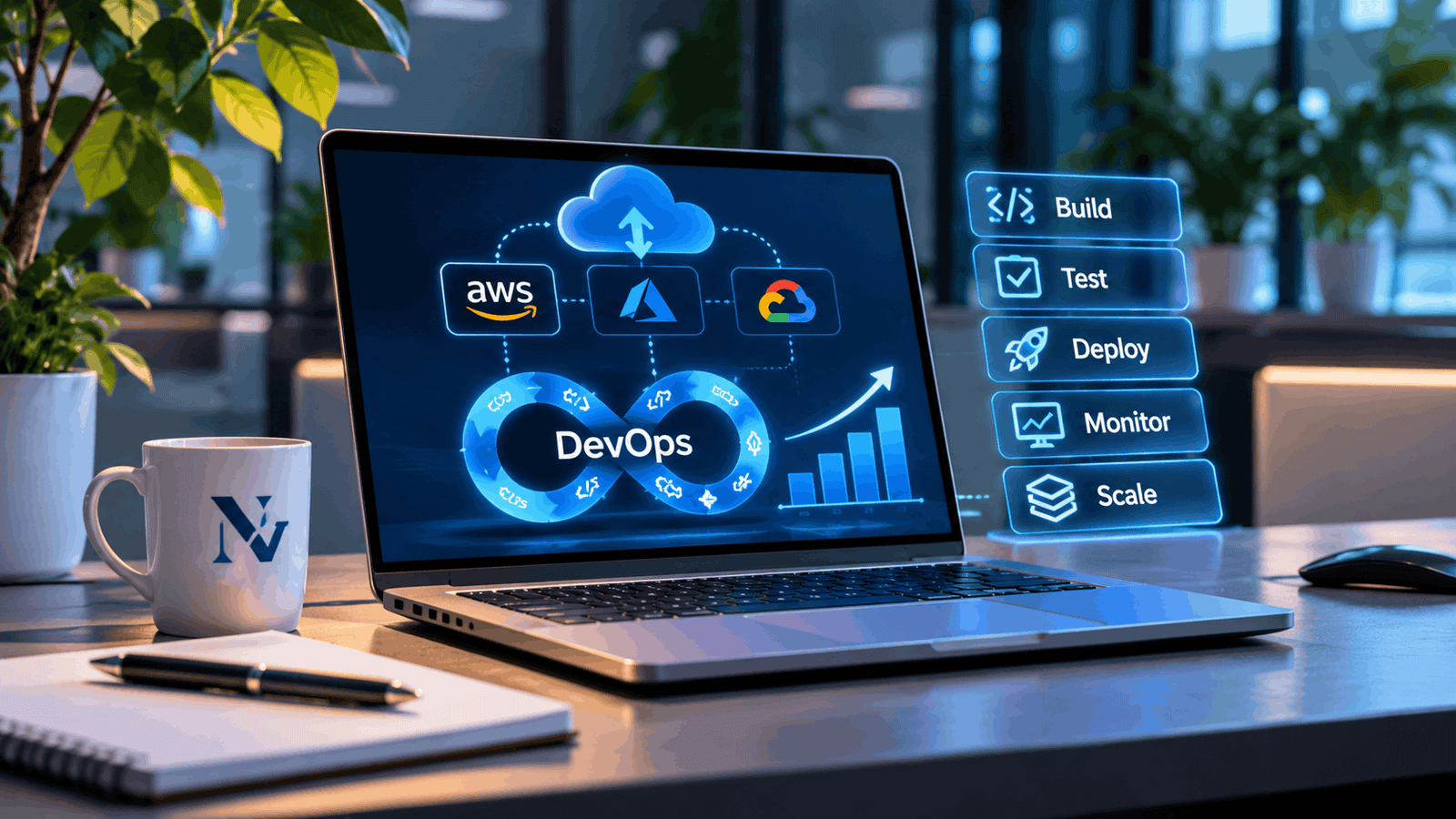
As a business grows, its technology needs also become more complex.
In the early stages, a small team may be able to manage deployments manually, run applications on basic infrastructure, and make technical changes whenever required. This approach may work well when the number of users, developers, and applications is still limited.
However, growth changes everything.
More customers can mean more website traffic. More developers can mean more application updates. More products and services can also create additional infrastructure that needs to be maintained.
At this point, manual processes may become slow, repetitive, and difficult to manage.
This is where DevOps and cloud services can help businesses create more reliable and scalable technology environments.
What Is DevOps?
DevOps is an approach that improves collaboration between software development and IT operations teams.
The purpose of DevOps is to make software development, testing, deployment, and maintenance more efficient.
Without DevOps practices, a developer may build an application and then manually send it to another team for deployment. This can create delays, communication problems, and differences between development and production environments.
DevOps helps reduce these problems through automation and better workflows.
For example, a company can create a deployment pipeline that automatically performs important steps when new code is submitted.
The pipeline may:
- Test the code.
- Check whether the application builds successfully.
- Prepare the application for deployment.
- Deploy it to a testing or production environment.
This process is commonly known as CI/CD automation.
CI/CD stands for Continuous Integration and Continuous Delivery or Deployment.
Instead of repeating the same deployment process manually every time, businesses can create a more consistent and repeatable workflow.
Why Cloud Infrastructure Is Important
Cloud infrastructure allows businesses to use computing resources without maintaining all physical servers themselves.
Platforms such as AWS and Microsoft Azure provide businesses with access to servers, storage, databases, networking, security tools, and many other services.
One of the biggest advantages of cloud infrastructure is flexibility.
Imagine an online business normally receives a moderate amount of traffic, but during a marketing campaign the number of visitors increases significantly.
If the infrastructure has been designed properly, cloud resources can be adjusted to handle the additional demand.
This can be more flexible than relying entirely on fixed physical infrastructure.
For growing businesses, cloud infrastructure services can provide an easier way to expand technology resources as business requirements change.
DevOps Helps Reduce Repetitive Manual Work
Many technical tasks are not difficult when they are performed once.
The real problem begins when the same task must be repeated again and again.
For example, imagine that a development team needs to follow ten manual steps every time a new version of an application is released.
If releases happen several times per week, the team spends a large amount of time repeating the same process.
Manual processes can also increase the chance of mistakes.
A team member may forget one step or configure something differently from a previous deployment.
DevOps automation can reduce this type of repetitive work.
Common tasks that can often be automated include:
- Software testing.
- Application builds.
- Deployments.
- Infrastructure provisioning.
- Monitoring.
- Environment setup.
Automation allows technical teams to spend more time improving products and less time repeating routine operational tasks.
Infrastructure as Code Makes Environments More Consistent
Another important DevOps concept is Infrastructure as Code, commonly known as IaC.
Traditionally, cloud resources may be created manually through a dashboard.
Infrastructure as Code allows technical teams to define infrastructure using configuration files.
Tools such as Terraform are commonly used for this purpose.
For example, imagine a company needs:
- Application servers.
- Networking rules.
- Storage.
- Cloud databases.
- Security configurations.
Instead of manually creating every resource each time, the infrastructure can be described in code.
This can make environments easier to reproduce.
It also allows infrastructure changes to be reviewed and tracked.
For growing businesses, this can make cloud environments more organized and easier to manage.
Monitoring Helps Detect Problems Earlier
Deploying an application successfully is only the beginning.
Businesses also need to know what happens after the application goes live.
Questions may include:
Are users experiencing errors?
Is the server running out of resources?
Has website performance become slower?
Are cloud costs increasing unexpectedly?
Monitoring and observability help technical teams understand what is happening inside applications and infrastructure.
Instead of waiting for customers to report a problem, monitoring tools can help teams identify unusual behaviour earlier.
Businesses may monitor:
- Application performance.
- Server health.
- Response times.
- Errors.
- Infrastructure usage.
- System availability.
This information can help technical teams respond to issues before they become larger problems.
DevOps and Cloud Can Support Business Scalability
Scalability means that a system can handle growth without requiring the entire technical environment to be rebuilt.
Consider a startup that launches an application with a few hundred users.
If the product succeeds, the number of users may increase significantly over time.
If the original infrastructure was not designed with growth in mind, increasing capacity may become difficult.
Cloud infrastructure can provide flexible computing resources.
DevOps practices can provide the automation required to manage those resources consistently.
Together, DevOps and cloud technologies can create a stronger foundation for businesses that expect their applications, users, or workloads to grow.
When Should a Business Consider DevOps Services?
Not every business requires a complicated DevOps environment.
A small website with simple requirements may not need advanced cloud architecture or complex automation.
DevOps becomes more useful when businesses begin experiencing problems such as:
- Slow or difficult deployments.
- Frequent deployment errors.
- Different environments behaving differently.
- Developers spending too much time managing infrastructure.
- Rapidly increasing application traffic.
- Repetitive technical processes.
- Difficulty monitoring applications.
- Growing cloud infrastructure.
The right DevOps solution depends on the actual business problem.
One company may only need a better deployment pipeline.
Another may require cloud migration, infrastructure automation, monitoring, or a broader DevOps strategy.
The goal should not be to use every available DevOps tool.
The goal should be to create a technical environment that is easier to manage, maintain, and scale.
How NextVora Solutions Supports DevOps and Cloud Projects
NextVora Solutions provides DevOps and Cloud services for businesses that want to improve the way they build, deploy, and manage applications.
Depending on project requirements, this may include areas such as:
- Cloud infrastructure.
- CI/CD automation.
- Infrastructure automation.
- Deployment workflows.
- Monitoring and observability.
- Scalable cloud environments.
- Container-based infrastructure.
The focus should always be on solving real technical and business problems.
For one business, this may mean reducing manual deployment work.
For another, it may mean improving cloud scalability or creating a more consistent infrastructure environment.
By combining DevOps practices with cloud infrastructure, businesses can create systems that are easier to operate as their requirements grow.
Final Thoughts
DevOps and cloud computing solve different problems, but they work very effectively together.
Cloud platforms provide flexible infrastructure.
DevOps provides the processes and automation required to manage that infrastructure more efficiently.
Together, they can help businesses:
- Automate software delivery.
- Reduce repetitive manual work.
- Create more consistent environments.
- Improve application monitoring.
- Prepare infrastructure for future growth.
For companies that are starting to outgrow manual technical processes, the right DevOps and cloud services can provide a more reliable foundation for long-term growth.