
Modern applications are becoming more complex.
A business may have multiple services, APIs, databases, background processes, and user-facing applications running at the same time. As these systems grow, managing them manually becomes difficult.
This is where Kubernetes and DevSecOps can become useful.
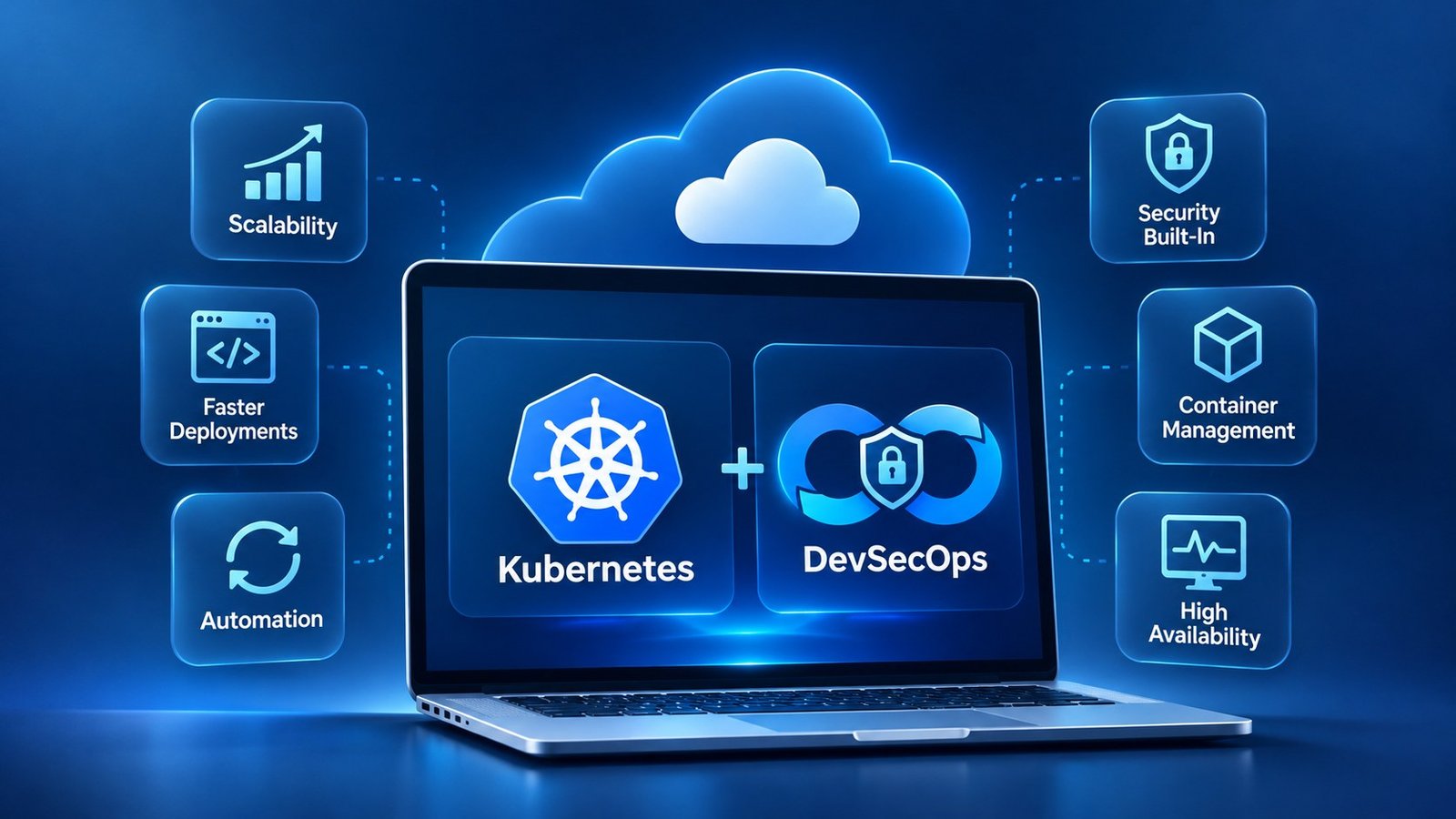
Kubernetes helps businesses manage and scale containerized applications, while DevSecOps focuses on integrating security into the software development and deployment process.
Together, they can help technical teams build systems that are not only scalable, but also more secure and easier to manage.
What Is Kubernetes?
Kubernetes is a container orchestration platform.
To understand Kubernetes, it first helps to understand containers.
A container packages an application together with the dependencies it needs to run. This can help make the application behave more consistently across different environments.
For example, if an application works correctly inside a container on a developer's machine, the same container can be used in testing or production environments.
However, managing a few containers is easy.
Managing hundreds of containers across multiple servers is much harder.
Kubernetes helps automate this process.
It can help with tasks such as:
- deploying containers;
- restarting failed applications;
- scaling applications;
- distributing workloads;
- managing updates;
- balancing traffic;
- maintaining application availability.
This makes Kubernetes useful for businesses operating modern cloud-native applications.
Why Businesses Use Kubernetes
One of the biggest reasons businesses consider Kubernetes is scalability.
Imagine a web application normally runs on three containers.
During a sudden increase in traffic, the application may need more resources.
Instead of manually creating additional instances, Kubernetes can help increase the number of running containers based on system requirements.
When traffic decreases, the number of containers can be reduced again.
This type of automation can make infrastructure more flexible.
Kubernetes can also help improve reliability.
If one container stops working, Kubernetes can attempt to replace it automatically.
This reduces the need for someone to manually restart the application every time a small failure occurs.
What Is DevSecOps?
DevSecOps stands for Development, Security, and Operations.
The main idea is simple:
Security should not be treated as something that is checked only at the end of a software project.
Instead, security should be considered throughout the development and deployment process.
In a traditional workflow, developers may build an application first and security testing may happen much later.
If a serious issue is discovered at the end, fixing it can become more difficult.
DevSecOps tries to identify security problems earlier.
This may include:
- code security checks;
- vulnerability scanning;
- container image scanning;
- dependency checks;
- secrets management;
- access control;
- infrastructure security checks;
- automated security testing.
The goal is to make security part of the normal development workflow.
Why Kubernetes Security Matters
Kubernetes provides powerful automation, but that also means the environment needs to be configured carefully.
A Kubernetes cluster may contain:
- application workloads;
- sensitive configuration;
- credentials;
- network connections;
- storage;
- internal services.
If access permissions are too broad or sensitive information is handled incorrectly, the environment may become vulnerable.
Kubernetes security therefore requires multiple layers.
For example, teams may need to control:
- who can access the cluster;
- what permissions each user or service has;
- how secrets are stored;
- which containers can communicate with each other;
- which container images are allowed;
- how workloads are monitored.
There is no single setting that makes a Kubernetes environment completely secure.
Security requires continuous attention.
Container Security Is Also Important
Containers can make application deployment easier, but they also need to be managed securely.
A container image may include outdated software packages or vulnerable dependencies.
If an insecure image is deployed into production, the problem can spread across the environment.
DevSecOps practices can help by scanning container images before deployment.
If a serious vulnerability is detected, the deployment can be stopped until the issue is fixed.
This helps teams identify problems before they reach production.
Kubernetes Can Improve Application Availability
Businesses often need applications to remain available even when individual components fail.
Kubernetes can help manage this through automated recovery.
For example, if an application container crashes, Kubernetes can start a replacement.
If a server becomes unavailable, workloads may be moved to another available node depending on the environment.
This does not mean Kubernetes automatically makes every application reliable.
The application and infrastructure still need to be designed properly.
However, Kubernetes provides tools that can support highly available systems.
DevSecOps Helps Reduce Security Risk Earlier
Security problems are usually easier to fix when they are identified early.
Imagine a developer accidentally includes a sensitive credential inside a project.
If the issue is detected immediately during development, it may be corrected before the application is deployed.
If the same issue reaches production, the business may need to rotate credentials, investigate access, and respond to a potential security incident.
DevSecOps reduces this risk by including automated checks throughout the development pipeline.
This can help businesses move faster without completely separating security from development.
When Does a Business Need Kubernetes?
Kubernetes is powerful, but it is not necessary for every business.
A small website with limited traffic may not need a Kubernetes environment.
Using Kubernetes for a simple project can introduce unnecessary complexity.
Kubernetes becomes more useful when businesses have:
- multiple containerized applications;
- microservices;
- frequent deployments;
- complex infrastructure;
- rapidly changing workloads;
- high availability requirements;
- multiple development teams;
- applications that need automated scaling.
The technology should match the actual requirements of the business.
When Does DevSecOps Become Important?
Security is important for every application, but DevSecOps becomes especially valuable when software is being developed and deployed frequently.
If a company releases updates regularly, manual security reviews may slow down the development process.
Automating appropriate security checks can help development teams identify problems without stopping every release for a completely manual review.
This is particularly useful for businesses operating cloud infrastructure, APIs, containerized applications, or complex software systems.
How Kubernetes and DevSecOps Work Together
Kubernetes manages application workloads.
DevSecOps helps ensure that those workloads are developed, tested, and deployed with security in mind.
A simplified workflow might look like this:
A developer updates the application code.
The CI/CD pipeline runs tests.
Security tools scan the code and dependencies.
The container image is created and scanned.
If the checks are successful, the application is deployed to Kubernetes.
The running application is then monitored.
This creates a more structured process where deployment automation and security work together.
How NextVora Solutions Supports Kubernetes and DevSecOps
NextVora Solutions provides Kubernetes & DevSecOps services for businesses building modern cloud and container-based applications.
Depending on project requirements, this may include areas such as:
- Kubernetes deployment and management;
- containerized infrastructure;
- CI/CD pipelines;
- DevSecOps workflows;
- container security;
- cloud-native application deployment;
- monitoring and observability;
- infrastructure security practices.
The objective is not simply to introduce Kubernetes because it is a popular technology.
A good technical strategy starts by understanding the application's requirements.
For some businesses, Kubernetes may provide valuable scalability and automation.
For others, a simpler infrastructure may be more appropriate.
The same principle applies to security.
Security controls should be designed according to the actual risks and requirements of the system.
Final Thoughts
Kubernetes and DevSecOps solve two important problems in modern software development.
Kubernetes helps teams manage, scale, and operate containerized applications.
DevSecOps helps teams integrate security into the development and deployment process.
Together, they can help businesses create systems that are:
- more scalable;
- easier to manage;
- better automated;
- more resilient;
- more security-aware.
For organizations operating complex cloud-native applications, combining Kubernetes and DevSecOps can provide a stronger foundation for reliable and secure software delivery.